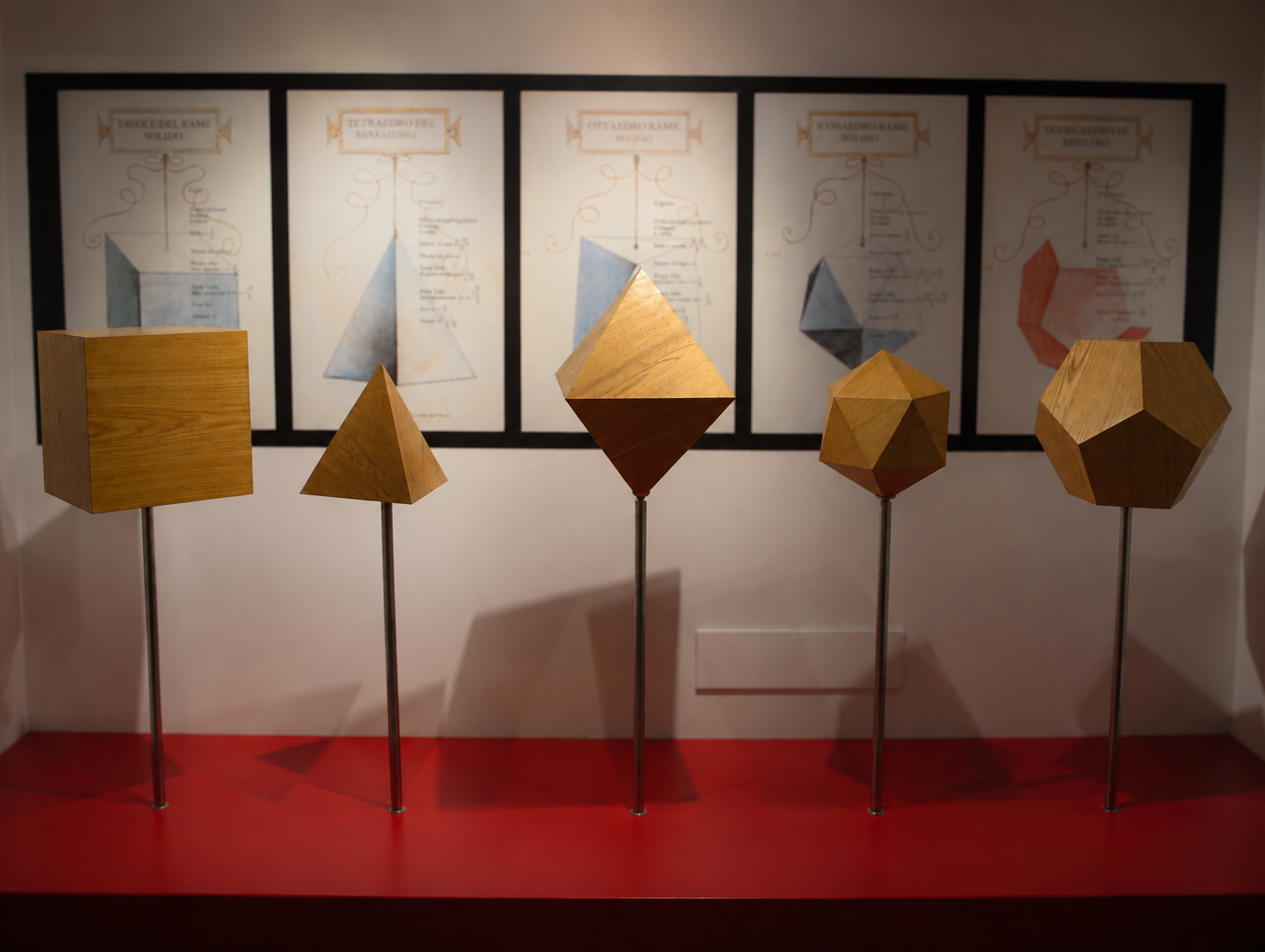
POLYHEDRA
Floor 3“God always geometrizes”
Platonic solids, or regular polyhedra, are the tetrahedron, lesaedron, loctahedron, dodecaedron and theIcosahedron.
From triangle they have the tetrahedron, the octahedron and the hyposaedron;
From square square square the hexaedron, or cube;
From pentagon the dodecaedro.
| Polyhedron | F | V | S | No | ♪ |
|---|---|---|---|---|---|
| tetrahedron | 4 | 4 | 6 | 3 | 3 |
| esaedro (cubo) | 6 | 8 | 12 | 4 | 3 |
| octahedron | 8 | 6 | 12 | 3 | 4 |
| dodecaedron | 12 | 20 | 30 | 5 | 3 |
| Icosahedron | 20 | 12 | 30 | 3 | 5 |
From the report Eulero F + V - S = 2 we get the following table (F = faces, V = vertices, S = edges, n = sides of each face, r = number of edges in each vertex).
Regular solids represented for Greeks the quintessence of beauty and the symmetry of space.
TIMELINE
Plato
(about 350 BCE)It associates the fire to the tetrahedron, the earth to the cube, the water to theicosahedron, the air to the octahedron and the shape of the universe to the dodecahedron.
Euclide
in the 465th proposition shows that regular solids are five, no more or less.
Fibonacci
(1220)In his Practice Geometry tackles the five regular polyhedra.
Luca Pacioli
(1445-1517)Treated several times in his books of regular polyhedra and semi-regulatory.
Kepler
(XVI-XVII century)It conceives a model of planet layout based on Platonic solids.
The mathematical analysis of the polyhedrons has obtained further developments, in recent times, with the topology, with the creation of spaces with dimensions greater than three, with the tilings and group structures in a continuous evolution that has no longer supported nor solutions of continuity.