M
← Back to the Archive

Doing Geometry

In making “geometry” we take care of figures with the intention of identifying the properties: and so we study quadrilaterals and spheres, circles and pyramids, but also points and straights and planes; these figures materialize with the design.

If the geometry, as Gonseth says, is the science of the figures in space, it is necessary that the school prepares situations in which the student can act, operate, modify, experiment; it is necessary that the school classroom transforms itself into a laboratory where it also works with the hands, where it is produced, where operativity becomes an active process of research that, starting from observations, structure, experiments, leads to the formation of concepts, to the possession of procedures and

On the other hand, pedagogy teaches us that the age range of 7-14 years corresponds to a critical phase in which the boy manifests a certain ability to generalize, to abstract, to always deduct from observations and manipulation of concrete objects. There is a saying, handed down to us by Greek philosophers, still valid today: “know is born from doing”, to become “sapiens” man must first be “faber”.

The Museum of Informatics and History of calculation, which is increasingly characterized as a museum-laboratory, as a significant centre of scientific dissemination addressed to the world of the School and the Comprehensive Institute of Pennabilli, which collects and serves all students of the school of the obligation of the municipalities of Pennabilli, S.Agata Feltria and Casteldelci (more than 500 students), have signed a collaboration agreement that brought, in the school year 2000/01F.

An interesting educational exhibition not only for the topic, basic in the curriculum of study of each student, but also because based on the “do”, on the activity, on the experiment. And this means for the teacher to put himself in the class as an animator, collaborator and guide; a teaching-learning process in which the teacher is not “in front” to the pupil but is “with” the student and with him learns.

An experience that involved all the classes of the former middle school and different disciplines: mathematics, technical education, science, history, Italian, artistic education.

The exhibition is structured in six moments: geopiani, origami, inviluppi, models, polyhedra, machines.

Some posters serve at first to clarify and recall the main terms of geometry and to distinguish geometric figures and recognize individual elements.

Elementary age: point, line, angle

Plain Geometry: polygons, regular polygons, circumference and circle

Solid geometry: polyhedra and rotation solids.

Rotation solids

GEOPANI

Some teaching tools are called “geopians” to encourage geometric experience. Designed by English pedagogical mathematician Caleb Gattegno are effective at different levels of learning. This subsidy consists of a wooden tablet on which a lattice is drawn whose knots are highlighted with kiosks or screws; among them elastic bands of different colour can be tended. The most different figures can be traced on geopiani; it becomes thus possible to represent and study different geometric situations: related to the shape and properties of the figures, the dimensions and extensions, symmetry problems, similarities, search for possible cases, classification and others. With a geoboard with 9 nails you can get all kinds of quadrilaterals: squares, robes, rectangles, parallelgrams, trapezi, deltoids, etc. The Pythagorean theorem or theorem of Carnot can be illustrated with a 16-inch geoboard.

With a geoboard with 25 nails you can build many angles or introduce the first concepts on the Cartesian plane or propose exercises on the axial and central symmetry or on the determination of the area of polygonal figures. Of course, increasing the number of geoboard nails, also increase the situations that can be proposed. It is evident that a geoboard with 121 nails can be used magnificently to introduce the Cartesian plane or for the equivalence of polygonal figures and to highlight the various elements. Another geoboard is that formed by a regular dodecagon-shaped reticulate and allows to represent equilateral triangles, squares, hexagons and dodecagons. Of the many activities that can be carried out with these tools it is good to keep in mind the opportunity that students reproduce on the notebook the situations and results achieved on the geoboard.

ORIGAS

Geometric Origami

The origami is a very old technique of Japanese origin that teaches to fold a sheet of paper, without ever cutting it and pasting it, to make figures of various nature and decorations. An interesting way, but still little known, to approach the fundamental geometric figures is geometric origami: by bending the paper sheet, based on symmetry properties, it is possible to obtain both flat geometric figures and three-dimensional geometric figures and all without using either the pencil or geometry tools. The only thing you need is paper.

With paper, using the technique of “modular origami”, the students have built flat geometric figures, Platonic solids, stellated polyhedra and curves in the plane: parable, ellipse, circumference, hyperbole, spiral.

DEVELOPMENTS

Geometric envelopes

The envelopes are graphical compositions using bearing structures consisting of a series of segments arranged neatly so as to offer the optical illusion of their envelope movement. The graphic construction begins with the determination of the supporting structure that can be composed of two or more segments willing to please. At the end of the graphic construction you get a composition of very elegant segments. The most interesting curves built by the boys are the parable, ellipse, hyperbole, circumference, asteroid, nephroid. Some of the curves obtained as straight envelopes can also be “coated” with needle and coloured wires or on light plywood tablets on which the nails were prepared including stretching or wires.

MODELS

Geometric models

In learning the geometry a young man normally passes through two stages: at first he takes suggestions and indications from the outside, from the objects that surround him, then, guided by intuition, he reworks the sensations that come from the senses and, little by little, separates the contingent from the essential and finally arrives at the absolute abstraction and the domain of pure logic. To help the student in this process, it is very useful to use specific teaching materials, to the so-called “geographic models”.

It is good for the boy to build from himself the teaching materials: this forces him to greater attention and often lead him to notices that highlight the most significant properties.

In this exhibition are presented some models, built by students, for triangles, for quadrilaterals, models for the discovery of the properties of isometrics, homothetie, for the equitension of flat figures, models for the Pythagorean theorem and more.

POLICY

Poliedri

A polyhedron is a system of ordinary polygons, called polyhedron faces, arranged in order to form a closed surface that delimites a finite portion of space whose points are the inner points of polyhedron. The sides and vertices of the faces are respectively the “spigoli” and the “vertical” of polyhedron.

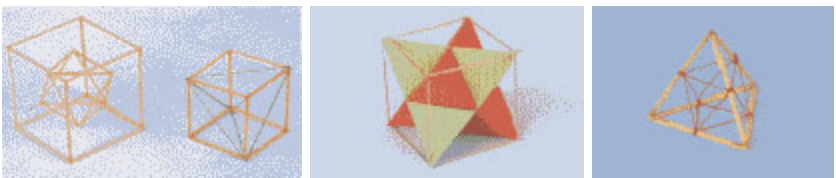
The regular polyhedra are five: tetrahedron, hexedron, octaedron, dodecaedron and icosahedron; they are also called “Platonic solids”. After Euclide he took care of Archimedes polyhedres who went to search for polyhedral forms that presented some regularities; 13 solids are known to regular faces called “ semi-regular polyhedres” or “Archimedean solids”. In addition to these, there are 13 solids called “ dual-archisms”. If you give up convexity but you maintain the condition that the faces of polyhedron are regular and congruent, you get another group of four regular polyhedra but concavi, the “stellated polyhedra” related to the names of Keplero and Poinsot.

Polyhedri models

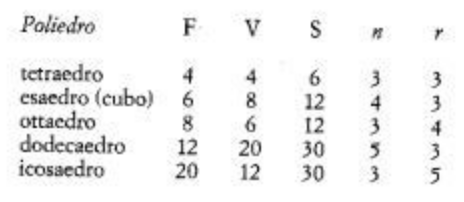
In studying the properties of the regular polyhedra it is interesting to experiment with the boys in which ways it is possible to combine triangles, squares and pentagons to compose a regular polyhedron. To calculate the number of faces, that of the vertices and that of the edges we will serve of the report of Eulero: F+V-S=2 and we will collect data in a table.

MACHINERY

Geometric machines

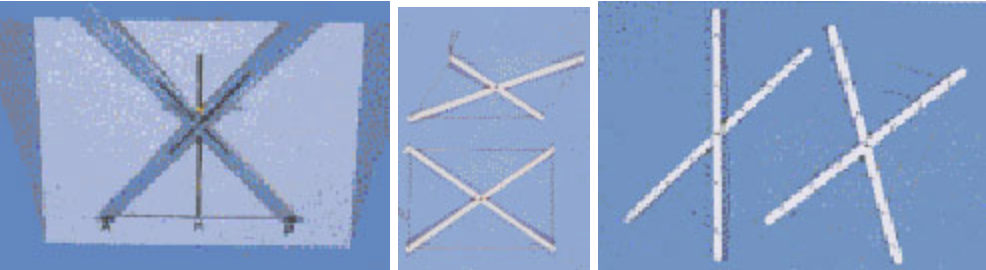
In everyday life there is often encountered in mechanisms of various types consisting of rigid rods among them hinged or sliding on each other. In each of these mechanisms there are moving parts that, interacting, transform a type of movement into another. In the pantograph, for example, if P is fixed and point A describes a curve then point B describes another curve that has the same shape as the first, but enlarged 2 times. It is very surprising in the students the discovery, due to Mascheroni in 1797, that “all the constructions that can be obtained with line and compact can be performed with only compact”. A mechanism to trace a straight segment is the Watt mechanism or the Peaucellier inverter to 7 hinged rods.

In 1875 Kempe showed that any algebraic curve can be traced with a linkage. But even for a simple curve like a conical the mechanism can be very complicated.

The students of the third classes have reconstructed the complete Watt mechanism (1784), Tchebyceff (1850) and Peaucellier (1864) to trace the straights, using the wood planks of the ice creams connected with pins; the quadrilateral articulated to draw curves of very different shapes; the conical compass to trace an ellipse.

Watt Mechanism

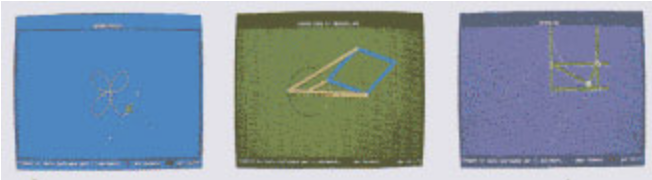
For the most complex mechanisms for tracking curves, computer simulations were used.

Simulation of the Watt mechanism

The preparation of the exhibition “fare geometry” has represented, for the boys, a positive experience and also involved those students who usually have difficulties with the teaching in a “traditional” way. The transformation of the school classroom into a sort of “laboratory of geometry” means considering mathematics as an experimental science.

We have experience, as teachers, that if the notions and concepts under definitions are not built in an operational way, they are not interiorized by the boys and will never be part of their cultural baggage. We know all the disastrous effects of a chalk-wash teaching.

Here is the need, and this exhibition is a modest example, to always and in any case resort to experimental activities that invest the boy directly with the most different forms of operation and guide him to the personal elaboration of definitions and rules.

the material for teaching the various authors, La nuova italia, Fi
euristic teaching of mathematics, Pedro Puig Adam, Uciim, Rome
on learning skills at the level of middle school, c.d.n.s.m., Rome
learning of mathematics, various authors, Pythagoras publishing, Bo
geometry operative, Rosa Rinaldi Carini, Graphic Arts Stibu, Urbania (Pu)
la geometry delle curve, Scuola Normale Superiore di Pisa, Carte segrete, Roma
the stories of Numeria, New Argos editions, Rome
Luca Pacioli and the Works of the Renaissance, Giunti publisher, Fi
Origami e geometry, Luisa Canovi, Demetra S.r.l., Bussolengo (Vr)

Curated by prof. Renzo Baldoni
Museum director