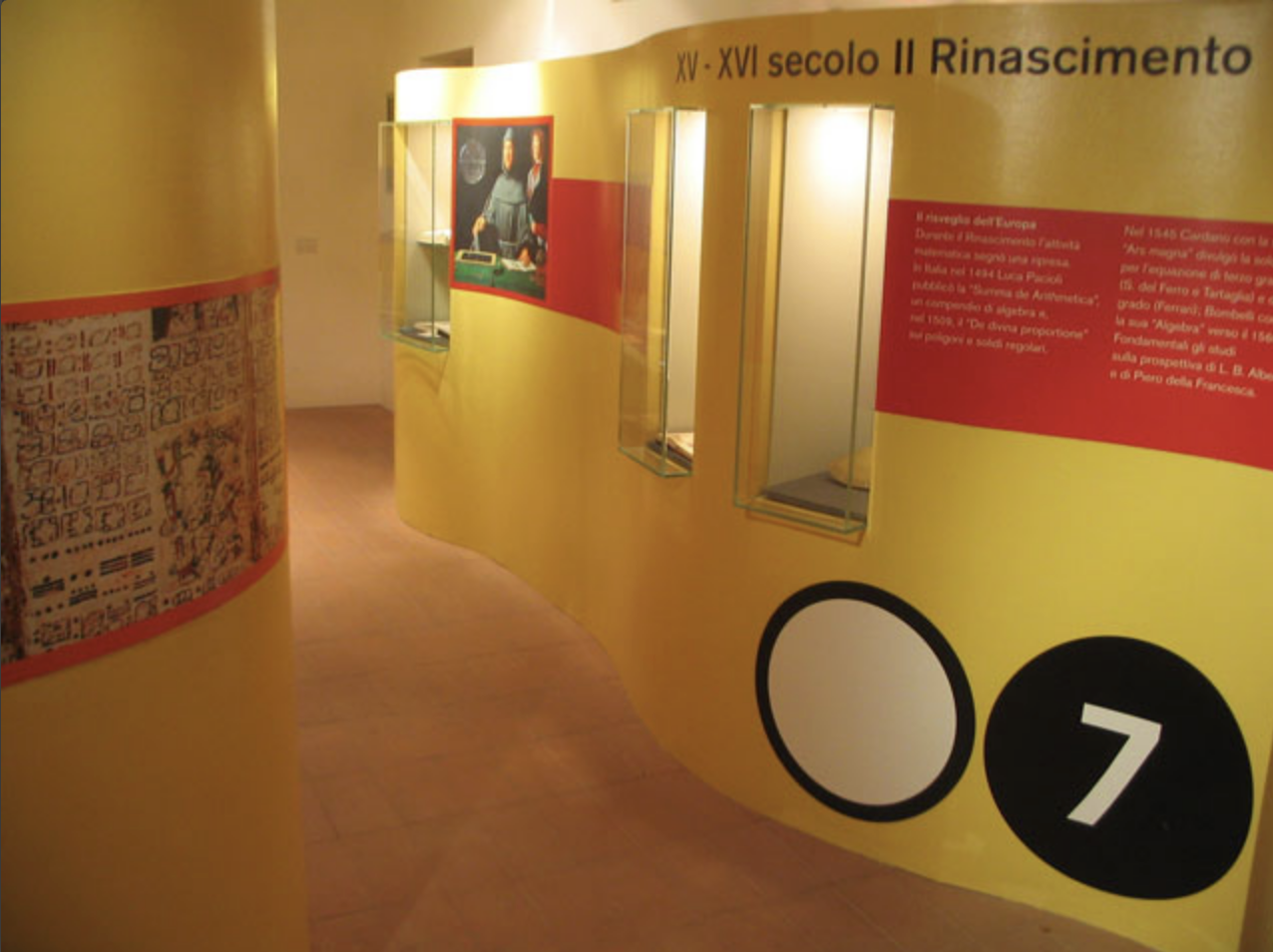
RENAISSANCE (SEC. XV-XVI) – The awakening of Europe
Floor 1During the Renaissance, activity began to mark a revival.
- In Italy in 1494 Luca Pacioli published the “Summa de arithmetica”, an algebra compendium and, in 1509, the “De Divina Proportion” on regular polygons and solids. In 1545 Cardano with his “Ars magna” He spread the solution for the third degree equation (S. del Ferro e Tartaglia) and fourth degree (Ferrari); Bombelli composed his “Algebra” 1560. Fundamental studies on the perspective of Leon Battista Alberti and Piero della Francesca.
- In Germany Riese, Rudolff, Apian and Stifel wrote numerous treatises of arithmetic and algebra.
- In England Recorde was, in fact, the only mathematician of a certain leverage throughout the 16th century.
- Central and eminent figure of this period was the French mathematician F. Viète who gave important contributions to arithmetic, algebra, trigonometry and geometry.
- We are also debtors to Copernicus, and his pupil Rheticus, for the contributions given to trigonometry and to Pietro Ramo for his contribution to teaching.
“
The mathematician Luca Pacioli in his Arithmetic summa (1494) summarizes the mathematical knowledge of the time.
Leonardo studies the proportions of the human body.