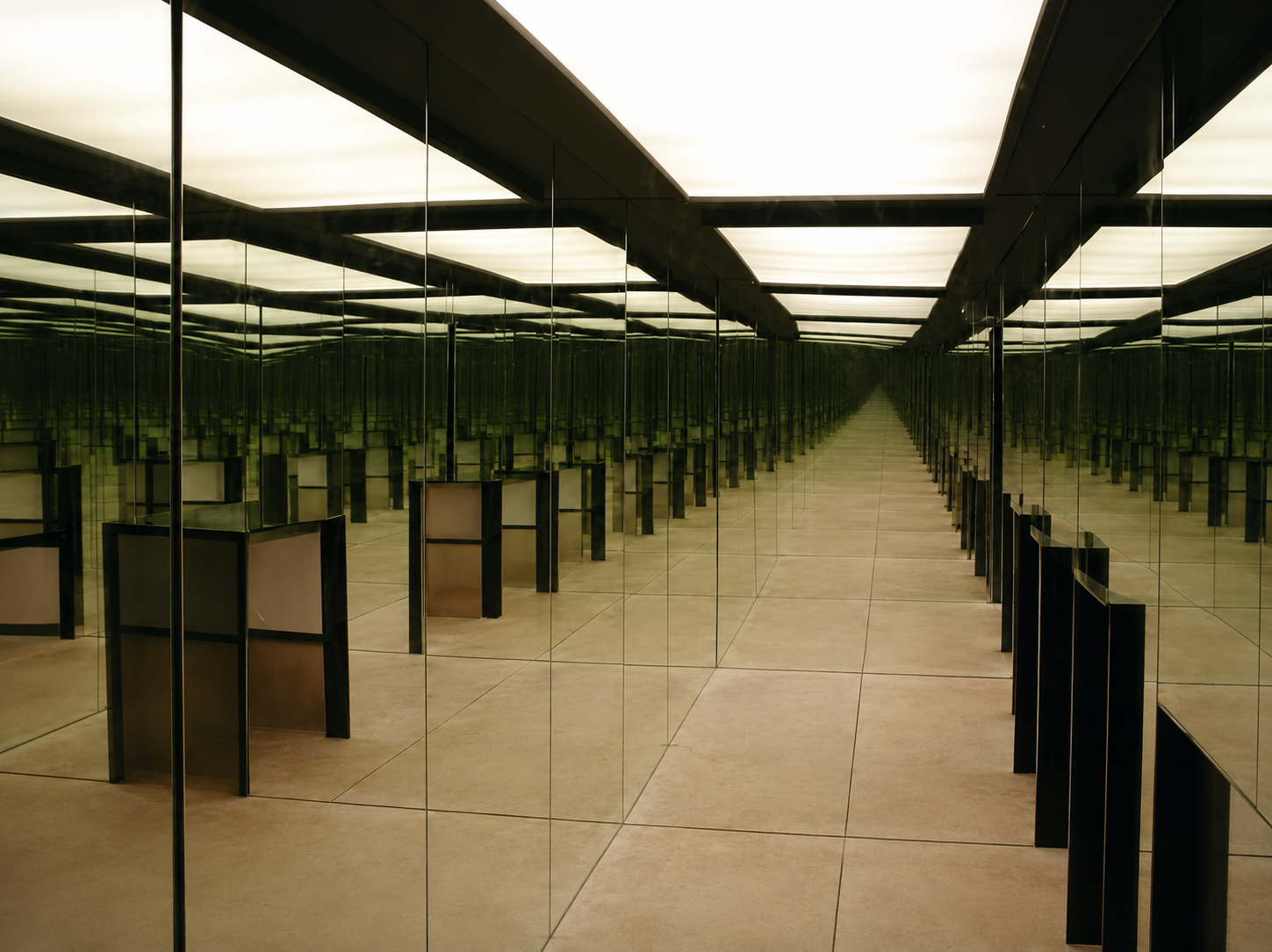
The INFINITY
Floor 4
“See a world in a grain of sand and a universe in a field flower, possess infinity on the palm of the hand and eternity in an hour”
Even if the world we live in is over, the way we need to study it involvesinfinity almost every step: the set of all natural numbers is an infinity set, the precise writing of the number pi Greek requires infinite decimal digits, the number of points on the smallest of the lines is infinity and so on.
Greek thought has been circulating for centuries withapeiron, the unlimited (Aristotle, Anassagora, Epicuro, Democritus). For two thousand years, the dominant idea in Western thought was the aristotelian idea of a potential infinity. In the 17th century, thanks to the objective geometry, the powerful infinity of philosophers becomes the current infinity of geometry.
It is due to the work of two German mathematics, Richard Dedekind and Georg Cantor, between 1870 and 1880, the rigorous and comprehensible definition of the concept of infinity, a crucial idea in the history of thought. Cantor demonstrates that the numberable or discreet infinity is not the only infinity; that not all infinite sets have the same cardinality, that there is an entire infinite hierarchy of infinites, which become ever greater.
Cantor processes a complete arithmetic of transfinite numbers (indicates them with the first letter of the Hebrew alphabet, aleph), with which he performs calculations just as he does with other numbers. The building built by Cantor was defined by the German mathematician David Hilbert “the most amazing product of mathematical thought, one of the most beautiful achievements of human activity in the field of pure intellect”.
Yet, on the margins of that building, there are important issues still without answer, “indecent” for Kurt Gödel and Paul Cohen.
Cantor's mathematical infinity paradise was not destroyed, but extended in its conceptual horizons, on new frontiers, even more fascinating.