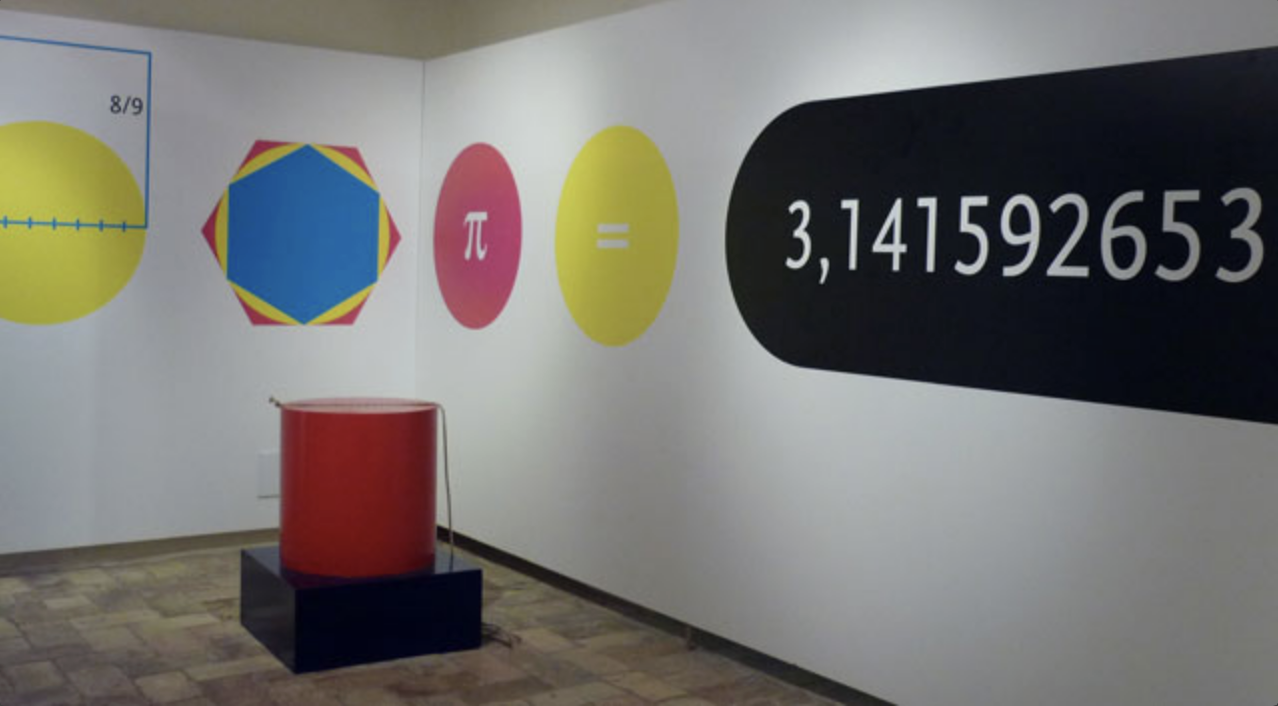
PI
Floor 3“This mysterious 3,14159... that enters from every door and from every window and that is under every roof. ”
The relationship between a circumference and its diameter, symbolically represented by π, is hidden in the rhythms of acoustic waves like those of the sea; it often intervenes in mathematics, physics, statistics, engineering, architecture, biology, astronomy and even in the arts.
The oldest documentation of the pi is on the papyrus of Rhind (1650 BCE): for the Egyptian scribe Ahmes π = 3,16049, a remarkable precision if we think that for the Babylonians and Jews, a thousand years later, the value was 3.
Archimedes (287-212 BCE), with the exhaustion method described in its Hoop measurement He found, as an average, π = 3,1419. On a Roman treaty of land surveying we find π = 4.
Throughout Asia the value of the most used Greek was the square root of 10 and it was also the value that spread from India to Europe, and that was used in Middle Ages by mathematicians from all over the world. Viète, in 1579, expressed for the first time π using an infinity product thus evolving the geometry towards advanced trigonometric identity and towards infinitesimal calculation. Significant, on π, the work of S (1621), Wallis, Pascal, Kepler, Knights, Stop and the fathers of infinitesimal calculation Leibniz and Newton and, in the middle of the eighteenth century, Eulero.
Today, thanks to computers, we have come to calculate the π up to 60 billion decimal figures.
The pi is a number irrational (Lambert, 1767) (his decimals never end) and transcendent (Lindemann, 1882), that is, it is not algebraic and cannot be built with a line and a compact and thus the square of the circle, a problem that had occupied the mathematicians from the time of the Hippocrates until modern times, it is impossible.
The fascinating Greek is a fixed theme of the culture taught by more than two and a half millennia and the mathematicians hope to reveal some of the mysteries surrounding π, a universal constant still not well known despite its relatively basic nature.