CHINESE, INDIAN AND ARAB MATHEMATICS
Floor 1
The year 529 CE, with the closure of philosophical schools, marks the end of the development of European mathematics in antiquity.
The seeds cast by Greek science flourish in the countries of Asia Minor and the Far East.
Trade from China to the West, through the Silk Road, makes travelling, along with goods, even ideas and techniques.
In the V century CE the mathematicians Indians they invent positional numbering with zero; only ten symbols to represent the numbers of the world.
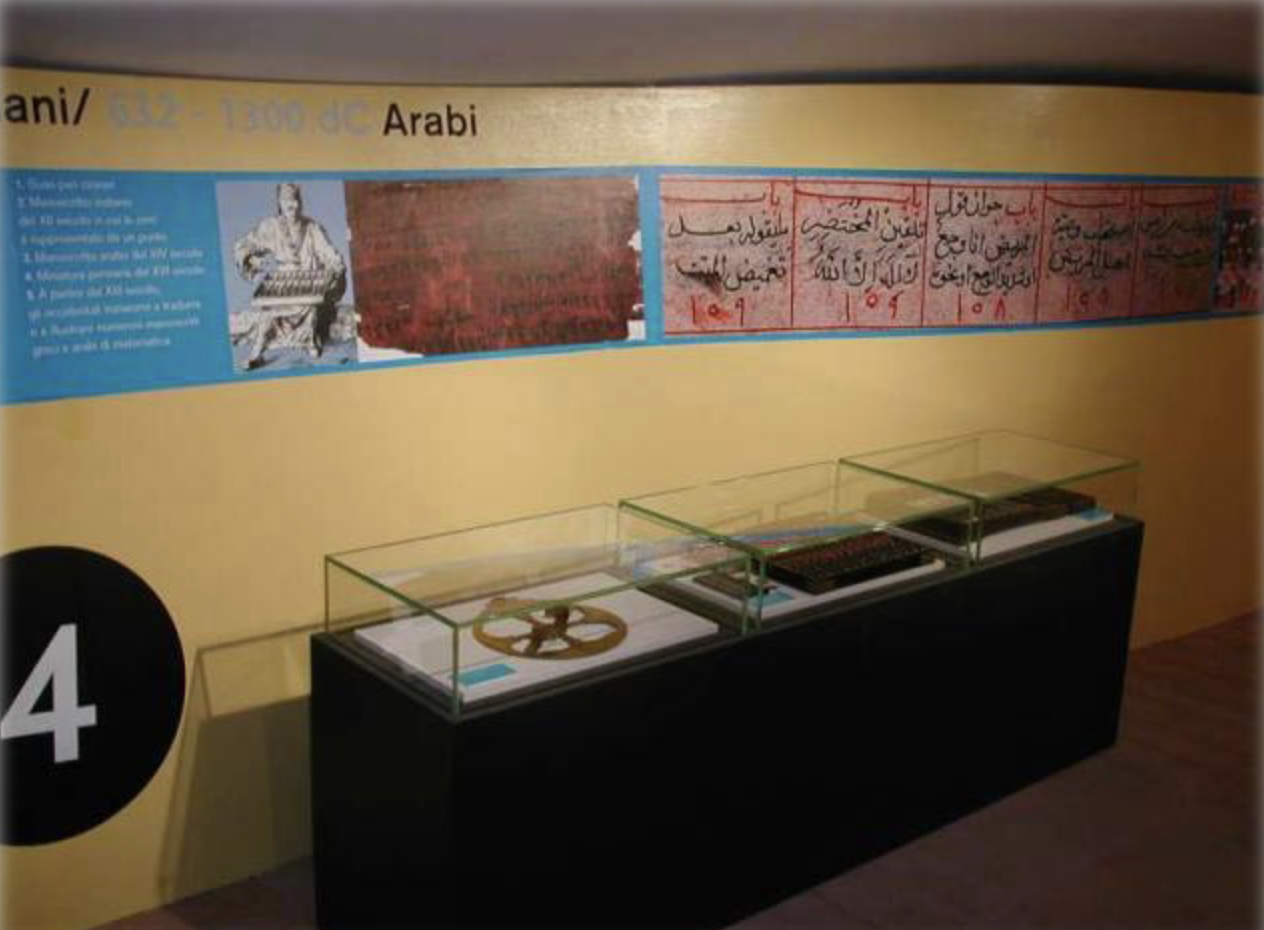
While Europe sinks into the darkness of the Middle Ages, the ArabsWith their achievements, they also spread the scientific knowledge of Oriental scholars: the spread of Indian numbers, the growth of algebra, the introduction of trigonometry, the dissemination of Greek geometry.
With a unique spirit of synthesis, they found the rigour of systematization of Greek mathematics and philosophers with the essentially practical aspect of Indian science and gave science a universal dimension.
In an attempt to trace the course of the stars, the Islamic astronomers of Middle Ages elaborated vast mathematical notions.
Beginning in the 13th century, Westerners began translating and illustrating numerous Greeks and Arab manuscripts of mathematics.