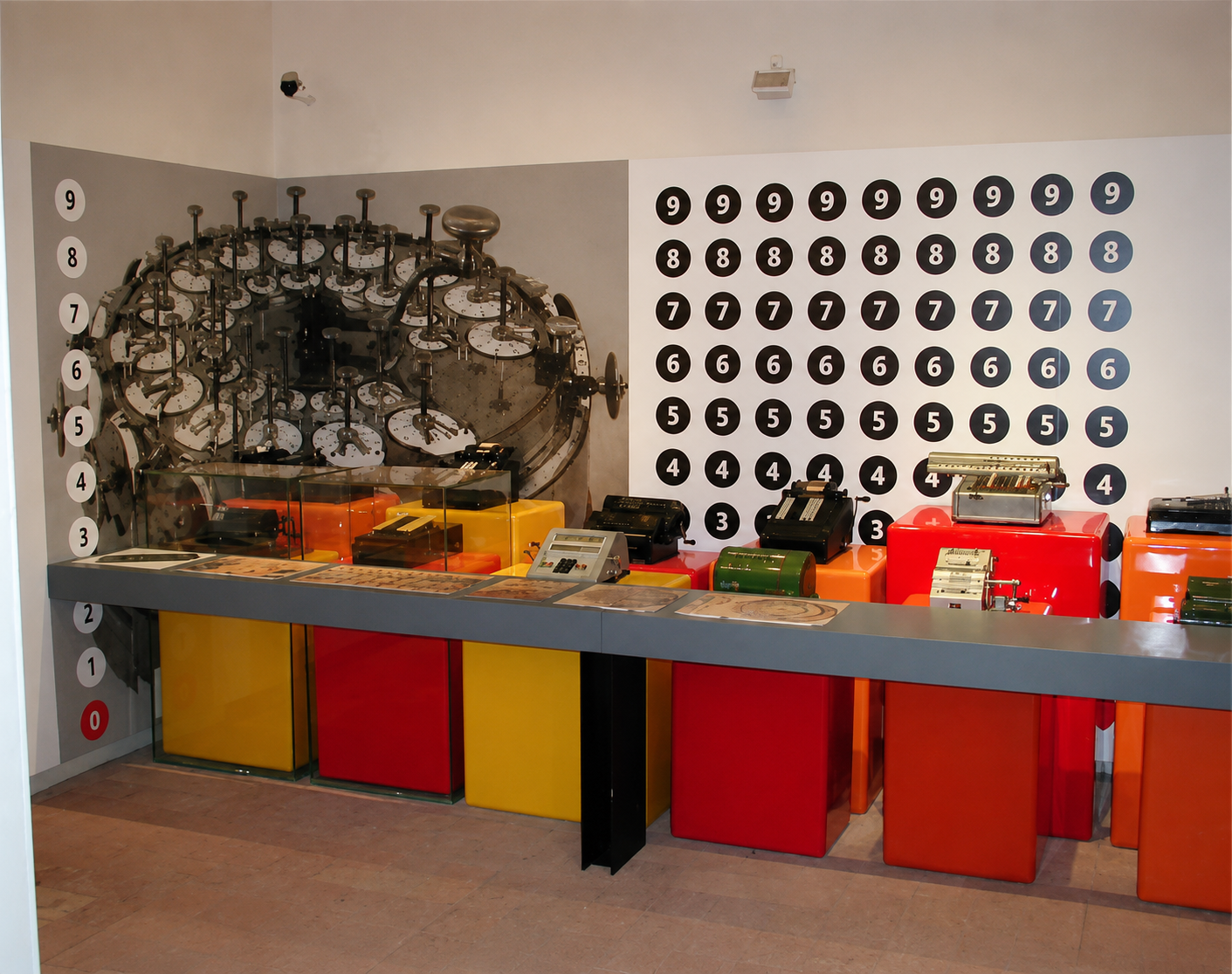
MECHANICAL CALCULATORS
Floor 2“It is not admissible that scholars and scientists, instead of drawing up and comparing new theories, lose their hours as slaves in calculation fatigues, which could be entrusted to anyone if they could use machines... ”
The fingers of the hands were the first method of calculation of history; the first support for the calculation were probably of stones (calculations in Latin) and the first artificial device (3,000 BCE) was theabacus with the various diversifications he has assumed in the various civilizations: Swan-pan in China, the soroban (Japanese abacus) in Japan, Tschote in Russia until Here you go Incas.
These simple duties remained in use for centuries and were used until the 18th century. The first machines with gears were designed in the early 17th century.
As in the aabacus, in which the basic operation is to count stones or balls, in a mechanical calculator count the teeth of a gear.
From manual calculation to machine
La Pascaline
The construction of these machines was possible with the help of the master watchmakers. To make a multiplication with the Pascaline (1645) it was necessary to make successive sums.
Morlan
Morlan he invented a machine with the same functions in 1666.
Leibniz
Leibniz, in 1694, with the introduction of wheel to scallops, built the first device capable of multiplying directly.
The arithometer
In 1820 T. de Colmar produced thearitometer, the first multiplier machine successfully marketed.
—
1892
Comptometer and Brunsviga
A further improvement occurred in 1892 with the Brunsviga by Odhner and with the Felt Comptometer of the 1887.