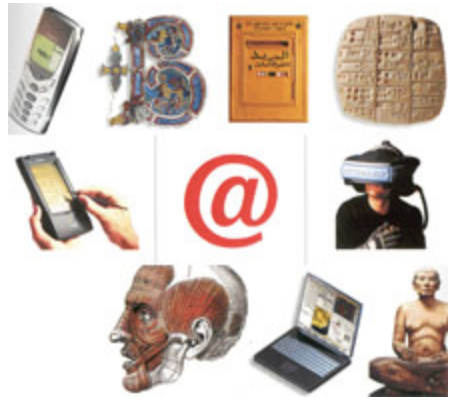
At the centre of the exhibition, a large tree with branches hangs the oldest books of Mateureka Museum. Ideally, in that tree, the whole knowledge of man is enclosed, from the Sumerian tablets with the first numerical signs on the clay, to the invention of systems to count and write the numbers linked to the development of commercial traffic and economic life. Give it to him. Elements of Euclide at the first book of mathematics, Larte de labbacho, printed in Treviso in 1478; from Arithmetic of Calandri with its precious Florentine Late Renaissance miniatures that make it, from an aesthetic point of view, the most beautiful book ever published, to the Summa and De Divina Proportion by Pacioli, with the 60 wonderful tables designed by Leonardo; from sheet 231 r of Codex Atlanticus in which is represented the way to find the root cube, Encyclopédie, colossal work with its idea of a unitary culture and the most unusual edition (1847) of First six books of the Elements of Euclide, hyperdecorated for the joy of fans of geometry and Victorian scientific aesthetics.
Around the tree are exposed, in original or in an anastatic copy, on several basins, some of the more than 1,400 ancient volumes (of the 1500s, 600s, 1700s) that the museum began to pour in digital format. In the attached workshop, a graphical roundup on how man builds knowledge, puts it in common, providing new knowledge and how writing became the memory of man. In concrete then it is explained how a book of mathematics is born showing the phases of processing of the last publication of Mateureka, the volume Mathematics ancient, of 400 pages with over 1,000 illustrations that present the mathematics and the peculiar aspects of 12 ancient peoples (Sumerians, Elamiti, Babylonians, Egyptians, Hittites, Phoenicians, Hebrews, Minoans, Mycenaeans, Greeks, Etruscans and Romans).
Thanks to multimedia stations you can consult, for example, all 1750 drawings on 1119 sheets of the Codex Atlanticus or all the Encyclopédie with its 23.135 pages and 3.132 tables or, much more simply, seize from a branch of the knowledge tree the desired book, in digital format, and enjoy it on your e-book reader.
It will be present during the exhibition prof. Renzo Baldoni, founder of Mateureka and author of the volume Ancient Mathematics, that currently deals with the project “From the fatigue to the pleasure of counting” with the goal of making understand and love the inherent because “the philosophy is the language of the universe” (Galilei) and “the most original creation of the human spirit” (Whitehead) and can represent for each of us the most fascinating adventures.