Cauchy is included among the founders of mathematical analysis for the theorems related to the existence and uniqueness of differential equation solutions; it is also the creator of the theory of complex variable functions.
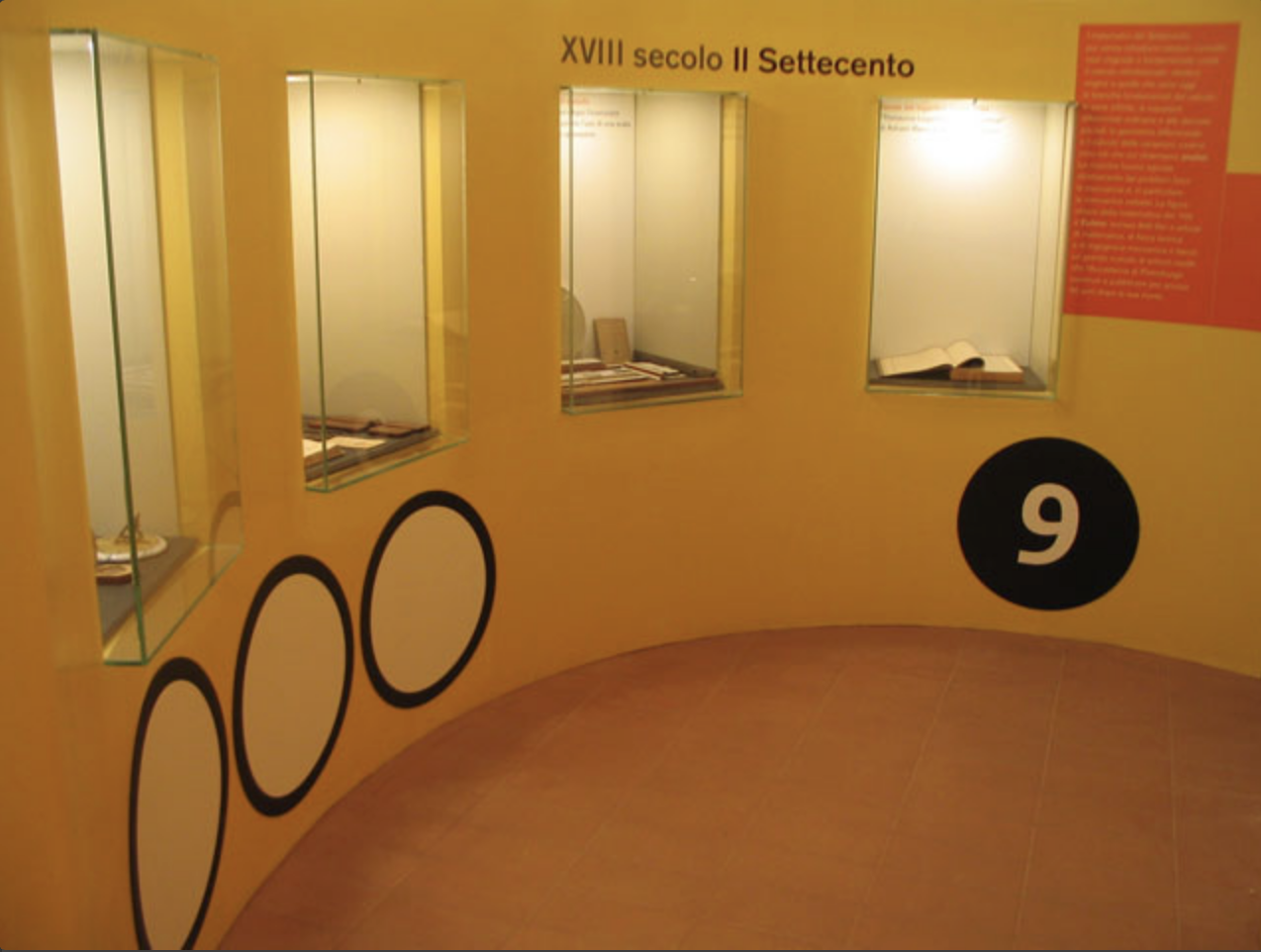
THE EIGHTEENTH CENTURY (18th Century)
Floor 1The mathematicians of the Eighteenth century, without introducing any concept as original or fundamental as the infinitesimal calculation, gave rise to those that are today the fundamental branches of the calculation: the infinite series, the ordinary differential equations and the partial derivatives, the differential geometry and the calculation of the variations; they built what we call mathematical analysis. The research was directly inspired by physical problems: mechanics and, in particular, celestial mechanics.
- The key figure of ’700’s mathematics is Eulero: He wrote 866 books and articles of mathematics and mechanical engineering, and left a large pile of unpublished articles that the Petersburg Academy continued to publish for 50 years after his death.
- The age of revolutions did not affect only the sphere of politics; I French mathematicians lived at the time of the Revolution were the promoters of the main development lines of the explosive proliferation of mathematics in the century Next.
- Between the 1700s and the 800s dominates the majestic figure of Gauss that, in 15 years, will renew the whole organization; its scientific production has been collected in 12 volumes. In the field of pure mathematics his work allowed the passage to non-euclide geometries.
- A Cauchy, genius of numbers, modern mathematics owes the systematic elaboration of the first basics of group theory.
Gauss was one of the greatest mathematicians of all time. He gave fundamental contributions in the field of integral computing, error theory, probability calculation and motion theory of celestial bodies and the laws of electromagnetism.